A 7-day space science kit · by 10timesIt
Your kid runs the mission. You just print the page.
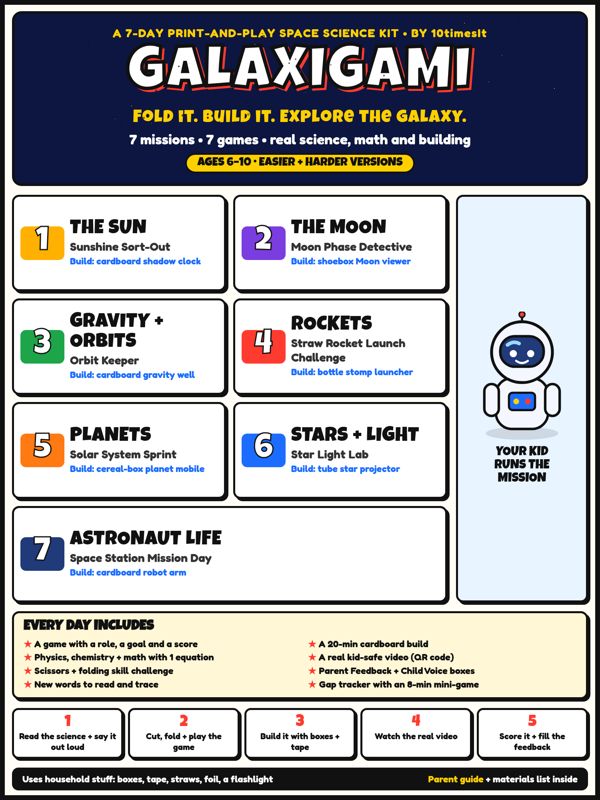
Seven comic-poster missions about the Sun, the Moon, gravity, rockets, planets, stars and life on a space station. Every day has a role, a goal, a score, one simple equation and a 20-minute cardboard build.
- Ages 6-10
- Easier + harder versions
- 10-page printable PDF
- About 5 minutes of prep a day
- Household materials
Launch price
Launch price: $29 for the first 20 families, then $47.
Get Galaxigami · $29Free 3-page sample (PDF)
Change-of-mind refunds are available for 1 day after purchase, refunded to your original payment method. If an item is defective, not delivered, or not as described, we will fix, replace, or refund it. See our Refund Policy.
Secure checkout by Stripe. One-time payment, instant PDF download. The price moves to $47 after the first 20 families; we'll post notice on this page before it changes. See our refund policy.
What your kid can do by Day 7
Explain the Moon's phases
With a lamp, a ball and their own words.
Launch and measure
Test a straw rocket at three angles and average the distances to find the best launch.
Do real space math
1,440 minutes ÷ 90 minutes per orbit = 16 sunrises a day on the space station.
Fold, cut and build
Something new from cardboard and household items every single day.
Seven missions
The Sun: Sunshine Sort-Out
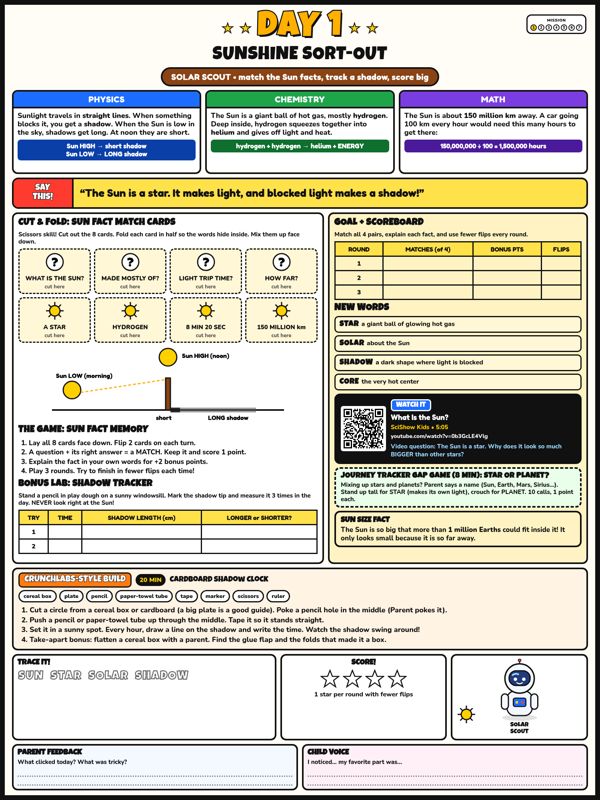
Role: Solar Scout. A Sun fact memory game, a shadow tracker and a cardboard shadow clock.
The Moon: Moon Phase Detective
Role: Moon Mapper. A lamp-and-ball phase race, a crater drop and a shoebox Moon viewer.
Gravity & orbits: Orbit Keeper
Role: Orbit Pilot. A paper-plate orbit, a drop race and a cardboard gravity well.
Rockets: Straw Rocket Launch Challenge
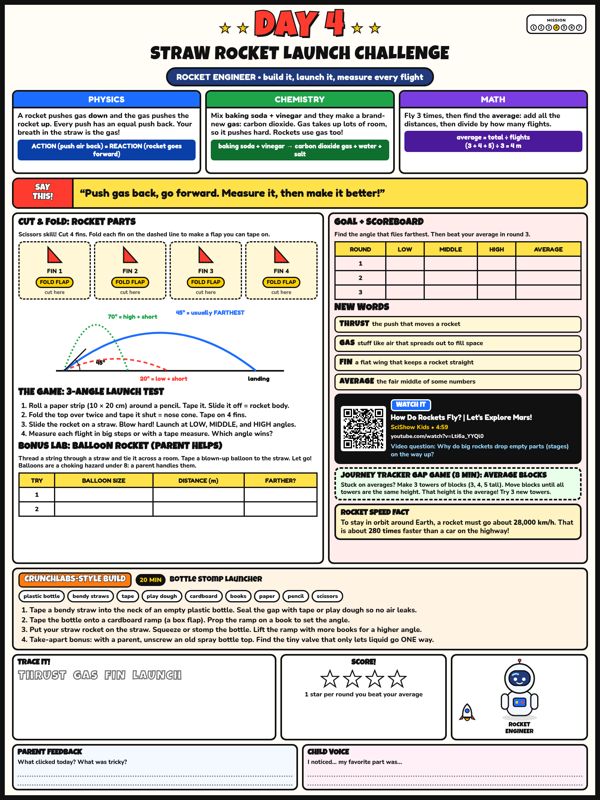
Role: Rocket Engineer. A 3-angle launch test, the average distance and a bottle stomp launcher. The balloon rocket is grown-up-handled.
Planets & scale: Solar System Sprint
Role: Planet Surveyor. A planet order race, a toilet-paper scale walk and a cereal-box planet mobile.
Stars & light: Star Light Lab
Role: Star Spotter. A ceiling constellation quiz, a near-and-far flashlight test and a tube star projector.
Astronaut life: Space Station Mission Day
Role: Mission Commander. A 4-station mission, solving 1,440 ÷ 90 = 16 sunrises, and a cardboard robot arm.
A look inside
Who it's for
- Parents and homeschool families who want a science week they can start today
- Kids ages 6-10, with easier versions for 5-7 and harder ones for 9-11
- Kids who learn by cutting, folding, building and playing
Who it's not for
- Families who want a full-year curriculum (this is a 7-day unit)
- Anyone who wants physical items shipped (it's a digital download)
- Grown-ups who don't want kids using scissors or doing hands-on builds
Questions
What ages is it for?
The main version is for ages 6-10. Easier versions fit ages 5-7, and harder versions fit ages 9-11.
How much prep time?
About 5 minutes. Print the day's sheet, gather the materials from the parent guide, and go. Each build takes about 20 minutes.
What materials do I need?
Mostly household items like cardboard, straws, tape, foil, a lamp, a ball and a shoebox. If you buy anything, it should come to under about $15.
How much screen time?
One short, hand-picked video a day (about 3 to 7 minutes), with a QR code on the sheet. You can watch each one first; the list is on the kit page.
Do I need a color printer?
Color looks best. Black-and-white works too; the text and score boxes stay readable.
What comes after Day 7?
We're planning new 7-day packs. They aren't available yet, and nothing renews automatically.
Who makes it?
Galaxigami is made by 10timesIt, a small independent publisher (10timesIt LLC). There are no testimonials on this page yet; we'll only add real ones from families who used the kit.